 Clearwater Roofing
 Building a Deck That Actually Holds Up in Palm Harbor
Palm Harbor sits close enough to the Gulf that salt air, humidity, and storm winds are part of daily life for anyone who owns outdoor structures. A deck built with generic, one-size-fits-all methods might look fine for the first year or two, then start showing problems: cupped boards, rusted fasteners, loose railings, or a substructure that's absorbed more moisture than it should. A custom deck built for this specific area needs to account for intense UV exposure nearly twelve months a year, wind-driven rain that gets under flashing and ledger boards if they're not detailed correctly, hurricane-force wind loads that stress every connection point, and salt-laden air that accelerates corrosion on anything that isn't rated for it.
This page covers what actually goes into a correct custom deck build for a Palm Harbor property — materials, structure, hardware, permitting, and process — so you know what to expect and what to ask for.
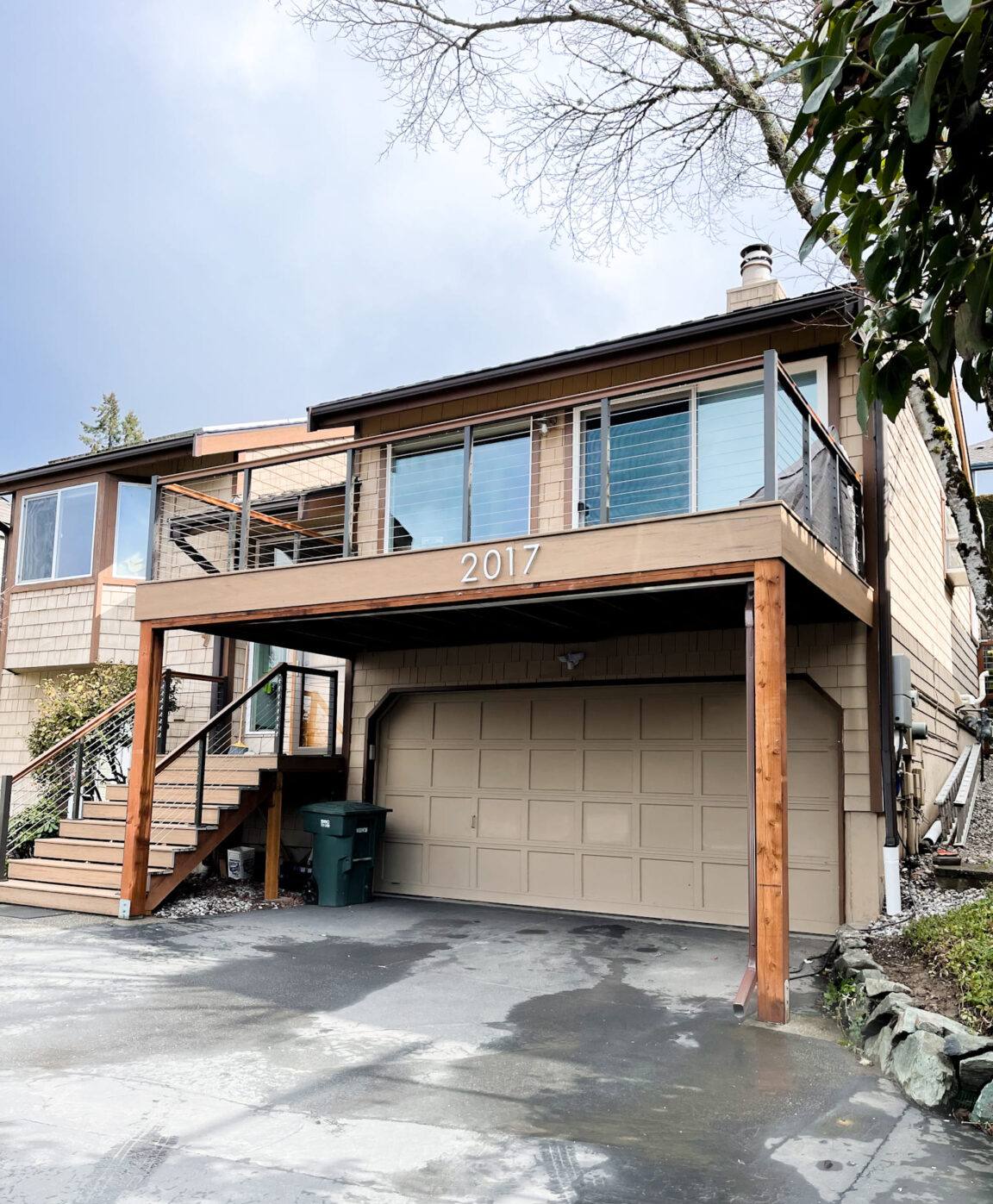
What Palm Harbor's Climate Does to an Outdoor Deck
Every material decision on a deck build traces back to four climate factors that are constant in this part of Pinellas County:
- UV exposure: Florida sun breaks down unprotected wood fibers and can fade or chalk lower-grade composite decking faster than manufacturers' marketing suggests.
- Wind-driven rain: Storms here don't just drop rain straight down — wind pushes water sideways and upward, forcing it into seams, fastener holes, and ledger connections that aren't properly flashed.
- Hurricane-force wind loads: Railings, posts, and ledger attachments all have to resist uplift and lateral force, not just support standing weight.
- Salt air: Even a few miles inland, airborne salt corrodes standard fasteners, connectors, and hardware over time, which is often the real reason older decks develop loose or failing joints.
None of these factors are unique to Palm Harbor, but together they're why a deck built to a generic national spec often underperforms here compared to one detailed specifically for coastal Pinellas County conditions.
Choosing Decking Material for a Palm Harbor Property
There's no single "best" decking material — the right choice depends on your budget, how much upkeep you want to do, and how much direct sun and moisture the deck will see. Here's an honest comparison of the options we build most often in this area.
| Material | How It Handles Sun & Heat | Moisture & Salt Air Behavior | Maintenance |
|---|---|---|---|
| Pressure-treated wood | Fades and can check/crack under sustained UV without regular sealing | Absorbs moisture; needs sealant reapplied to resist wind-driven rain | Annual cleaning and resealing recommended |
| Tropical hardwood (e.g., ipe) | Naturally dense and UV-resistant, but will gray without oiling | Very moisture-resistant when properly finished | Periodic oiling to maintain color; otherwise low |
| Capped composite | Cap layer resists fading and heat damage better than uncapped composite | Doesn't absorb water; resists salt exposure well | Occasional washing; no sealing or staining |
| PVC decking | Fully synthetic; strong resistance to UV fading | Doesn't absorb moisture at all; well suited to salt air | Lowest — soap and water cleaning |
We install all of these, but for homes closest to the water or exposed to constant salt spray, capped composite or PVC decking is usually the more sensible long-term choice because there's no wood fiber for moisture to work into. Real wood still has its place — it has a warmth and appearance some homeowners specifically want — but it comes with a real maintenance commitment that composite and PVC don't require.
A Note on Uncapped Composite
Early-generation uncapped composite decking has a known weak spot in humid climates: without a protective cap layer, the wood-plastic blend can absorb moisture at the surface and is more prone to staining, mold growth, and swelling over time. It's not that the product is unusable — it's that in a climate as humid and rainy as ours, the extra protection of a capped product is worth the modest price difference. That's a maintenance and moisture-behavior trade-off, and it's why we default to capped or PVC products for most Palm Harbor installs.
Framing and Structure: Where a Deck Actually Fails
Decking boards get all the attention, but the framing underneath is what determines whether a deck lasts. A correct build in this climate includes:
Ledger Board Flashing
Where a deck attaches to the house, the connection has to be properly flashed to keep wind-driven rain from working its way behind the ledger board and into the home's wall assembly. This is one of the most common failure points on older or poorly built decks — water intrusion here can cause hidden rot long before it's visible from outside.
Post Footings and Connections
Footings need to be sized and set to local frost-free depth and soil conditions, with post bases that keep wood off standing water. Every structural connection — post to beam, beam to joist, joist to ledger — needs load-rated hardware, not just nails, to resist the uplift forces that hurricane-strength wind puts on an elevated structure.
Joist Spacing and Board Direction
Joist spacing has to match the decking material's span rating — composite and PVC products often require tighter joist spacing than solid wood to avoid deflection over time. Getting this wrong is a common shortcut that shows up years later as a bouncy or uneven deck surface.
Hardware and Fasteners: The Detail That Determines Longevity
Salt air is hard on metal, and it doesn't take direct beachfront proximity for corrosion to become a problem — airborne salt travels well inland throughout Pinellas County. Standard galvanized fasteners can corrode faster than expected in this environment, and mixing incompatible metals (for example, the wrong screw with the wrong bracket) can trigger galvanic corrosion that eats away at connections from the inside.
For Palm Harbor builds, that means:
- Stainless steel or coated fasteners rated for coastal/ACQ-treated lumber compatibility
- Structural connectors matched to the decking manufacturer's engineering specs
- Railing hardware rated for wind load, not just decorative weight
- Cable or rod railing systems, if chosen, tensioned and hardware-rated for coastal corrosion resistance
This is a place where cutting corners is invisible at first and expensive later — corroded hardware is a leading cause of premature railing and structural failure on older Florida decks.
Permits, Codes, and Wind Load in Pinellas County
Most new decks and significant deck rebuilds in Pinellas County require a building permit, and the design has to meet Florida Building Code wind load requirements for our region. That affects footing depth, post sizing, railing attachment, and guardrail height and spacing if the deck is elevated. Permitted work also means an inspector verifies the framing and connections before the decking surface goes down — which is exactly the stage where problems are easiest to catch and hardest to see once the boards are installed.
We handle the permitting process as part of the build, including preparing the plans an inspector needs to see and scheduling the required inspections. Skipping permits on a deck project isn't just a compliance issue — it can create real problems at resale, since an unpermitted structure often has to be disclosed and may need to be brought up to code before a sale closes.
Our Custom Deck Process
- On-site consultation: We walk the property, discuss how you'll use the space, and assess sun exposure, drainage, and structural attachment points.
- Design and material selection: We go over decking material, railing style, layout, and any features like built-in seating or multi-level design, with honest guidance on trade-offs for each option.
- Estimate and plan: You get a clear, itemized estimate along with the design details before any work begins.
- Permitting: We prepare and submit the permit package and coordinate required inspections with Pinellas County.
- Construction: Footings, framing, decking, and railing are installed in sequence, with structural work completed and inspected before the surface materials go down.
- Final walkthrough: We review the finished deck with you, cover care and maintenance specifics for the material you chose, and address any final details.
Maintaining a Deck in Palm Harbor's Climate
Even low-maintenance materials benefit from a seasonal routine in this climate. A little attention goes a long way toward protecting the investment:
- Rinse the deck surface periodically to remove salt residue, pollen, and organic buildup
- Check railing posts and hardware annually for corrosion or looseness, especially after storm season
- Inspect ledger board flashing and the area where the deck meets the house for signs of water staining
- Clear leaves and debris from between boards to prevent moisture retention and staining
- For wood decks, plan on resealing or refinishing on the schedule the product requires — don't wait until it looks damaged
- After any major storm, do a quick visual check of railings, stairs, and structural connections
Why a Palm Harbor-Experienced Crew Matters
A deck built by a crew unfamiliar with coastal Pinellas County conditions can still look good on installation day — the problems that come from wrong fastener choices, inadequate flashing, or undersized footings usually show up months or years later. A crew that regularly builds in Palm Harbor and the surrounding Clearwater area already knows the local permitting process, the wind load requirements that apply here, and which material and hardware combinations actually hold up to this specific mix of sun, salt, and storms. That local experience translates directly into fewer surprises during the build and a deck that performs the way it's supposed to for years afterward.
What Affects the Cost of a Custom Deck
Every deck project is different, but the same handful of factors drive most of the cost variation we see on Palm Harbor jobs:
| Factor | Why It Matters |
|---|---|
| Size and footprint | Square footage is the biggest single driver of material and labor cost |
| Height and structure | Elevated decks require more substantial footings, framing, and stairs than ground-level builds |
| Decking material | Pressure-treated wood costs less upfront; composite and PVC cost more initially but less over time in upkeep |
| Railing style | Standard baluster railing is more economical than cable, glass, or custom metal railing systems |
| Site access and prep | Difficult access, grading, or existing structure removal add labor time |
| Permitting complexity | Elevated or larger structures may require more detailed engineering and inspection steps |
We give straightforward, itemized estimates so you can see exactly what's driving the cost of your specific project rather than a vague lump-sum number.
If you're considering a new deck or need to replace one that's showing its age, we're happy to take a look and put together a free, no-pressure estimate for your Palm Harbor property using the form below.