 Clearwater Roofing
 Siding in Sunset Point Has to Do More Than Look Good
Sunset Point sits close enough to Clearwater Harbor and the surrounding waterways that homes here take a harder hit from the elements than siding manufacturers assume in their generic installation guides. Salt-laden air moves off the water and settles on exterior walls, sun exposure is intense and nearly year-round, and when storms roll through Pinellas County, wind-driven rain gets forced sideways into every seam, joint, and fastener hole a siding job leaves exposed. On top of that, this part of Florida sees genuine hurricane-force wind loads, not just the occasional gusty afternoon.
None of that is a reason to avoid siding — it's a reason to be precise about what you put on the house and how it goes up. A siding product that performs fine in a mild inland climate can fail years early here if it's the wrong material, or installed by a crew that doesn't understand what coastal Clearwater conditions actually demand. This page covers what we look at when we're pricing and installing fiber cement siding for a Sunset Point home, and why the product and the install method both matter as much as the price on the estimate.
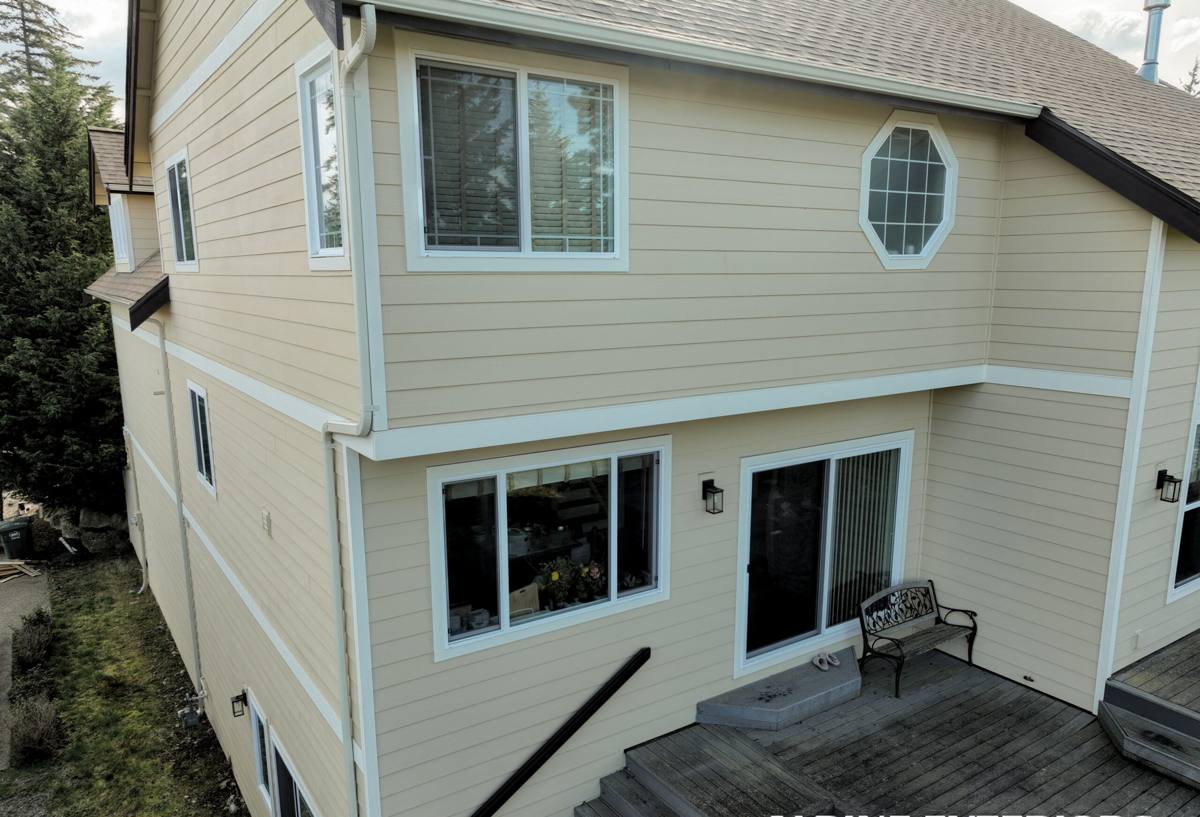
Why Fiber Cement Is the Right Call Near the Water
Fiber cement siding is a blend of cement, sand, and cellulose fibers, pressed and cured into boards that don't rot, don't feed insects, and don't warp the way wood-based products can when they take on moisture. That matters directly in a neighborhood like Sunset Point, where humidity stays high and salt air accelerates the breakdown of anything that isn't built to resist it.
We install James Hardie fiber cement exclusively. We don't offer vinyl siding, LP SmartSide, Cemplank, Allura, or primed wood products like spruce or cedar. That's not a marketing position — it's a standard we hold because of what we've seen play out on real homes over time in this climate:
- Vinyl can warp, fade, and crack under sustained UV exposure and doesn't hold up as well against wind-driven debris in storm-force gusts.
- LP SmartSide and other engineered wood products use wood strand cores that are more sensitive to sustained moisture exposure than cement-based siding, which is a real concern in a humid, storm-prone coastal area.
- Cemplank and Allura are also fiber cement products and share some of Hardie's core advantages, but we've standardized on one system so our crews install it correctly every time and warranty coverage is never a question mark.
- Primed cedar or spruce requires the most ongoing maintenance of any option here and is the least forgiving of gaps in paint or caulk near saltwater exposure.
James Hardie is non-combustible, holds paint and factory finish exceptionally well, and Hardie engineers specific product lines for humid, high-UV, high-moisture climates like ours — which is the next thing worth understanding before you commit to a product line.
James Hardie's Climate-Engineered Lines for Florida
Hardie doesn't sell one siding product nationwide. The company engineers regional formulations under its HZ5 and HZ10 designations specifically for climate zones like ours, where humidity, heat, and moisture exposure are constant rather than seasonal. For a Sunset Point home, that distinction is not a technicality — it's the difference between a board engineered to shrug off our climate and one that was never meant to see it.
On top of the base material, Hardie's ColorPlus factory-applied finish is baked on under controlled conditions rather than field-painted, which gives it more consistent adhesion and better fade resistance under the kind of relentless sun Pinellas County gets most of the year. That matters for a coastal-adjacent home where a job-site paint job is more likely to show early wear from UV and salt exposure than a factory finish will.
Style Options That Still Fit the Neighborhood
Hardie's lineup covers lap siding, vertical board-and-batten, and shingle-style panels, so matching an existing Sunset Point streetscape or updating a dated exterior are both realistic without sacrificing the performance upgrade.
What a Correct Installation Actually Involves
Fiber cement siding is only as good as the install behind it. Most of the failures we get called out to inspect on homes near the coast trace back to installation shortcuts, not the material itself. A correct job in a climate like this includes:
- Proper clearance and flashing at every window, door, and roofline transition, so wind-driven rain has nowhere to collect against the wall assembly.
- A code-compliant weather-resistive barrier installed and lapped correctly behind the siding, giving the wall a second line of defense if water ever gets past the cladding.
- Correct fastener type, spacing, and penetration — under-driven or over-driven nails are one of the most common causes of early siding failure, and it's an easy thing for a rushed crew to get wrong.
- Manufacturer-specified gapping and caulking at joints and butt seams, done with a sealant rated for sustained UV and moisture exposure, not whatever caulk was left on the truck.
- Attention to wind uplift requirements for our wind zone, since Pinellas County's building code reflects the real hurricane exposure this area faces.
None of this is exotic. It's just detail work that takes longer to do right, and it's exactly where cutting corners shows up first — usually a few years down the road, after the crew that installed it is long gone.
Our Process for a Sunset Point Siding Project
1. On-Site Assessment
We walk the exterior, check the current siding and underlying sheathing for hidden moisture damage, and note anything storm exposure or age has already compromised. This is also where we talk through style, color, and whether a full tear-off or a more limited scope makes sense.
2. Detailed Estimate
You get a written scope covering material, prep work, flashing and moisture-barrier detail, and timeline — not just a lump-sum number. We want you to know exactly what's included before you sign anything.
3. Prep and Removal
Old siding comes off, the sheathing gets inspected and repaired where needed, and any rot or moisture intrusion found underneath gets addressed before a single new board goes up. Installing new siding over a compromised wall assembly just hides a problem instead of solving it.
4. Installation to Manufacturer Spec
Weather barrier, flashing, fastening, and caulking are all done to James Hardie's published installation requirements for our climate zone — the same details covered above, done consistently across the whole house.
5. Final Walkthrough
We go over the finished work with you directly, check trim and paint lines, and make sure everything matches what was scoped at the estimate.
What Fiber Cement Siding Projects Typically Cost
Every home is different, and we don't quote real numbers without seeing the property, but the factors below are what actually move a fiber cement siding estimate up or down. Use this as a guide for what to ask about when comparing quotes.
| Cost Factor | Why It Matters |
|---|---|
| Home size and wall complexity | More square footage and more corners, gables, and dormers mean more cutting, fitting, and labor time. |
| Full tear-off vs. partial replacement | Removing and disposing of existing siding, and repairing any sheathing found underneath, adds cost but is often necessary to do the job right. |
| Siding profile and style | Lap siding, board-and-batten, and shingle-style panels differ in material and labor requirements. |
| Number of stories and access | Second-story and hard-to-access walls require more scaffolding or lift equipment and slower, more careful work. |
| Trim, soffit, and fascia scope | Coordinating trim work with siding replacement affects both material cost and the finished look. |
| Color and finish selection | Factory ColorPlus finishes vary in cost by color and sheen relative to standard options. |
Broadly, fiber cement siding sits in a mid-to-upper range compared to vinyl, reflecting both the material cost and the longer service life you get in exchange. We'll walk through where your project falls on that range once we've seen the home.
Maintenance and Longevity Near the Water
One of the practical advantages of fiber cement in a neighborhood like Sunset Point is how little ongoing maintenance it demands compared to wood-based siding. It won't rot, it resists pest damage that wood products are vulnerable to, and the factory finish holds color far longer under UV exposure than field-applied paint typically does.
That doesn't mean zero maintenance. Salt air residue benefits from an occasional rinse-down, caulked joints should be checked periodically for wear, and any impact damage from storm debris should get addressed promptly rather than left to sit. Installed and maintained correctly, Hardie siding is built to hold up for decades in exactly the conditions Sunset Point sees — that's the point of choosing a climate-engineered product in the first place.
Why Local Installation Experience Matters
A crew that already works in and around Sunset Point and greater Clearwater understands the specific wind-load requirements Pinellas County's building code sets for this area, knows what permitting and inspection actually involve locally, and has already seen how siding performs on homes with this exact exposure to salt air and coastal storm patterns. That's different from a crew installing siding here for the first time, using generic detailing that was never tested against what this climate actually throws at a house.
Before hiring anyone for a fiber cement siding project in this area, it's worth confirming a few things:
- Are they James Hardie factory-trained or certified installers, not just general contractors who occasionally install siding?
- Do they carry proper licensing and insurance for exterior work in Pinellas County?
- Will they put the installation scope — flashing, weather barrier, fastening — in writing, not just a material list?
- Do they pull the required permits, or ask you to skip that step?
- Can they explain how their installation accounts for wind uplift and wind-driven rain specific to this area?
- Do they inspect and repair sheathing before installing new siding, rather than covering existing damage?
If a contractor can't answer those clearly, that's worth treating as a warning sign before work starts, not after.
Get a Straight Answer on Your Siding Project
If your Sunset Point home's siding is showing its age, took storm damage, or you're just planning ahead for what this climate will eventually demand, we're happy to take a look and give you an honest read on what it needs. Reach out for a free, no-pressure estimate using the form below.