 Clearwater Roofing
 Building a Deck on Island Estates: What's Different
Island Estates sits on the water in Clearwater, and that changes what a deck needs to survive. A deck built the same way you'd build one five miles inland, away from the salt air and open water exposure, will show problems faster here — corroded hardware, cupped boards, soft framing — sometimes within a couple of seasons instead of a couple of decades. Building correctly the first time costs more up front in material and fastener choices, but it's the difference between a deck that needs real repair work in year three and one that's still solid after fifteen years of Gulf Coast weather.
We build decks across Clearwater and Pinellas County, but Island Estates gets treated as its own case. Waterfront and near-waterfront lots deal with constant salt-laden air, more direct sun exposure with less tree cover in many yards, and wind loads that inland framing details don't always account for. None of that is exotic — it's just physics and chemistry that a deck built to a generic spec sheet won't fully respect.
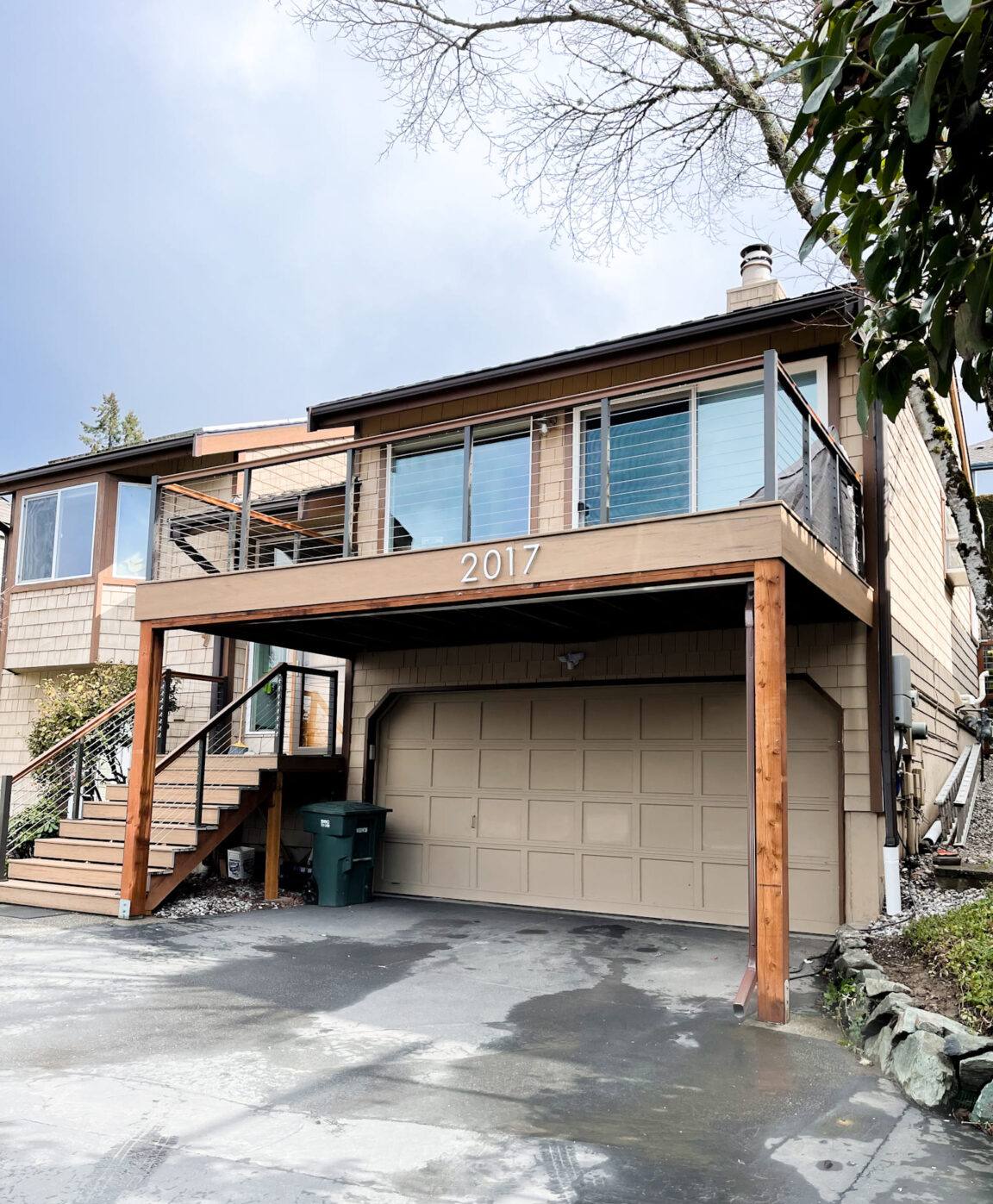
What Salt Air, Sun, and Storms Do to a Deck Here
Salt Air and Corrosion
Airborne salt is the biggest hidden threat to a waterfront deck. It settles on every surface, works into joints and fastener heads, and accelerates corrosion in metal that isn't rated for coastal exposure. The failure isn't usually dramatic — it's slow. A screw head rusts, weeps a stain into the board around it, then eventually loses grip. Multiply that by a few hundred fasteners in a deck and you get a structure that looks fine from a distance but is quietly losing integrity where it counts.
UV and Heat
Florida sun is intense year-round, not seasonal, and a deck facing open water often gets more direct exposure than one tucked under mature trees. UV breaks down the surface fibers of wood and the resin binders in composite decking over time, which is why color fade, graying, and surface checking show up faster here than the national averages you'll see printed on a product box.
Wind-Driven Rain and Moisture
Wind-driven rain doesn't just fall on a deck — it drives sideways and up under railings, into ledger connections, and into any gap that isn't properly flashed or sealed. Combined with the region's humidity, that moisture doesn't dry out as quickly as it would in a drier climate, which is exactly the environment that leads to rot in untreated wood and hidden decay in structural framing.
Storm Wind Loads
Clearwater sits in a coastal wind zone, and homes near open water catch more of it than homes set back inland. A deck's railing posts, guard connections, and ledger attachment all need to be built to resist uplift and lateral load, not just support the weight of people standing on it. This is a structural requirement, not an upgrade option.
Material Choices for Waterfront Decks
There's no single "best" decking material — every option is a trade-off between upfront cost, maintenance, and how it holds up to salt air and sun. Here's how the common choices compare for an Island Estates setting:
| Material | Upfront Cost | Maintenance | Salt Air / Sun Performance | Typical Lifespan |
|---|---|---|---|---|
| Pressure-Treated Pine | Lowest | Regular sealing/staining needed | Vulnerable to fastener corrosion staining and UV graying without upkeep | 10-15 years with maintenance |
| Composite Decking | Mid to High | Low — occasional washing | Good UV and moisture resistance; quality varies by product line | 20-25+ years |
| Tropical Hardwood | High | Periodic oiling to maintain color | Naturally dense and rot-resistant; still needs UV-rated finish | 20-30 years |
| PVC Decking | High | Very low | Excellent moisture resistance; can run hotter underfoot in full sun | 25-30+ years |
We don't push one product line as the automatic answer. A composite or PVC board reduces long-term maintenance, which matters if you don't want to be out there sanding and sealing every year or two — but it costs more up front, and not every composite is engineered the same way for coastal moisture cycling. Pressure-treated wood costs less at install but asks for a real maintenance commitment to hold up here. We'll walk through what you actually want to maintain versus what you want to spend once and mostly forget.
Framing, Fasteners, and Footings Built for the Conditions
The decking surface is what you see, but the framing underneath is what determines whether the deck is still safe in ten years. In a coastal, salt-air environment, that means:
- Stainless steel or coated fasteners rated for coastal/marine-grade exposure — not standard interior-grade hardware
- Joist hangers, hurricane ties, and structural connectors matched to the same corrosion-resistant standard as the fasteners
- Ledger board attachment properly flashed and sealed against the house to stop wind-driven rain intrusion at the connection point
- Footings sized and set to local soil conditions, which on barrier and near-water lots can include sandy or variable soil that behaves differently than typical inland ground
- Post-to-beam and beam-to-joist connections built to resist uplift, not just gravity load
- Airflow and drainage under the deck so moisture doesn't sit and stall against framing members
None of this is visible once the deck is finished, which is exactly why it matters who builds it. A deck that looks identical from the surface can have very different fastener and connector specs underneath — one built for a dry inland yard, and one actually built for salt air and coastal wind.
Permitting and Code Requirements in Clearwater and Pinellas County
Deck construction in Clearwater requires a permit, and inspections check structural framing, footing depth, ledger attachment, and railing/guard height and spacing before the deck is signed off. Pinellas County's building code accounts for the region's wind exposure, which is part of why a coastal deck's structural connections carry real engineering weight, not just carpentry preference.
Skipping or shortcutting the permit process is one of the most common ways homeowners end up with problems later — at resale, with insurance, or when a deck genuinely isn't safe under load. We pull permits, build to the inspected structural requirements, and handle the inspection process as a normal part of the job, not an extra step.
Our Process, From Estimate to Finished Deck
The process is straightforward and doesn't change based on how nice we're hoping the finished deck looks:
- On-site assessment. We look at your lot, sun exposure, existing structure (if replacing a deck), and how close you are to open water, since exposure varies even within Island Estates.
- Material and layout discussion. We go over decking material trade-offs honestly, including what each option actually costs you in upkeep over time, not just at purchase.
- Written estimate. Clear scope, materials, and cost before any work starts.
- Permitting. We handle the permit submission and coordinate required inspections with the city and county.
- Construction. Framing first, built to the structural and fastener standards above, then decking, railings, and finish work.
- Final walkthrough. We review the finished deck with you before calling the job done.
Maintaining a Deck in an Island Climate
Even a well-built deck needs some ongoing attention in this environment. A short seasonal checklist keeps small issues from becoming structural ones:
- Rinse salt residue off the deck surface and railings periodically, especially after storms with onshore wind
- Check fastener heads and connectors for early rust staining and address it before it spreads
- Inspect the ledger board connection at the house for any sign of water staining or soft wood
- Keep gaps between boards clear of debris so water can drain and airflow underneath isn't blocked
- Reseal or refinish wood decking on the schedule the product actually calls for, not just when it looks faded
- After any major storm, walk the deck and check railing posts and stair connections for looseness before using it
Why a Local Island Estates Crew Matters
A crew that regularly works Island Estates and similar Clearwater waterfront neighborhoods already knows the wind exposure, the soil behavior on near-water lots, and which fastener and framing specs actually hold up here — versus a crew that builds mostly inland and treats a coastal deck like any other job. That local pattern recognition shows up in the details: how the ledger is flashed, what grade of hardware gets used without being asked, and how footings are set for the actual ground on your lot rather than a generic spec.
It also means we're not guessing at Clearwater's permitting process or Pinellas County's inspection expectations — we've been through them enough times that the paperwork and scheduling side of the job moves without surprises.
Get a Straightforward Estimate
If you're planning a new deck or need to replace one that's showing its age on Island Estates, we're happy to walk your property, talk through material options honestly, and give you a clear, no-pressure estimate. Use the form below to get started.